Plaza de Mayo in Argentina
Plaza de Mayo in Argentina
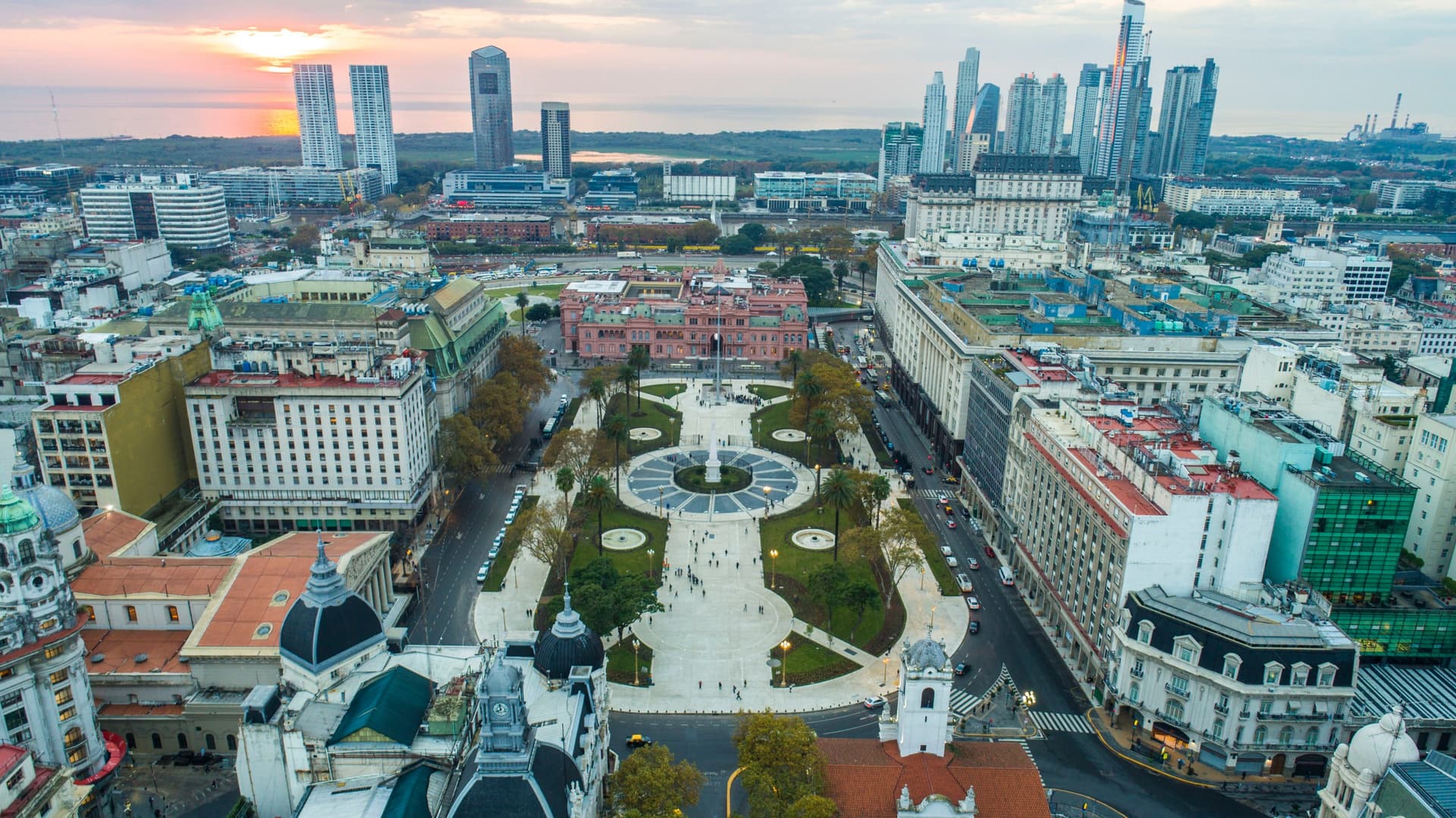
The political heart of Argentina since 1580, Plaza de Mayo brings together Casa Rosada, Cabildo, and the heritage of the Mothers at the center of Buenos Aires.
In the heart of Buenos Aires stands an emblematic square that has played a central role in Argentina's political and social history: Plaza de Mayo. This is a paved esplanade surrounded by historic and governmental buildings. With its tree-lined pathways and shaded benches, it offers an open space where citizens gather, express their views, and participate in the evolving urban life of Buenos Aires. A tour of the square awaits.
Its History
Plaza de Mayo, or Plaza de Mayo in Spanish, took its current form in 1884 following the demolition of a colonnade that separated two distinct squares. However, its origins trace back to the founding of Buenos Aires in 1580 by Juan de Garay. Originally, it resulted from the merger of two neighboring squares, Plaza de la Victoria and Plaza del Fuerte, after the removal of a structure in 1884 that divided them. Jesuit ecclesiastics obtained a portion of the square in 1608. But in 1661, the local governor acquired the eastern half to incorporate it into the park of the city's new fortress.
After years of overuse, a colonnade was erected in 1804 to bring order to the square. In 1883, with the demolition of the colonnade, the modern Plaza de Mayo came into being. Its emergence marks a significant milestone after more than a century of evolution and minor changes in the square's configuration.
This square is celebrated for the action of the Mothers and Grandmothers of Plaza de Mayo, wearing white headscarves. They are indeed an Argentine human rights defense association. Their mission was to locate babies and children who disappeared during the military dictatorship from 1976 to 1983, a symbol of resistance, and to return them to their families of origin. This is how these women came to be nicknamed the "madwomen of Plaza de Mayo."
The Beautiful Plaza de Mayo Today
Today, Plaza de Mayo remains an unmissable tourist attraction for Buenos Aires visitors. Around this emblematic square stand several of the city's principal monuments:
- the Cabildo, the former colonial municipal council, stands on the west side of the square on Bolívar Street and houses the National Historical Museum of the Cabildo
- Casa Rosada, the seat of the nation's executive power (President of the Republic)
- the Metropolitan Cathedral of Buenos Aires, located at the corner of Avenida Rivadavia and Calle San Martín
- the Pyramid of May
- the equestrian monument of General Manuel Belgrano
- the current city hall
- the headquarters of the Bank of the Nation
Exploring the area on foot is the best way to soak in its atmosphere. Wander around this verdant central square and take time to admire the imposing buildings dating from the nineteenth century. Among the must-sees for photo stops are Casa Rosada and the Metropolitan Cathedral. However, other notable buildings also deserve your attention, such as the National Bank (Banco de la Nación) and the Cabildo, the former city hall.
From the square, you can head south to reach the lively markets and tango clubs of San Telmo, east to discover the parks and bars of Puerto Madero, or north along the main shopping street, Florida Street.
Visiting Plaza de Mayo
Also called Plaza Mayor, Plaza de Mayo stands out as the city's central site and major square. Located in the financial district of Microcentro in Monserrat, it is also Buenos Aires' oldest and most famous square and represents Argentina's political heart while being the emblematic place where demonstrations regularly take place.
Its boundaries are defined by Bolívar, Hipólito Yrigoyen, Balcarce streets and Avenida Rivadavia, with three major avenues—Avenida Presidente Julio Argentino Roca, Avenida Roque Sáenz Peña, and Avenida de Mayo—originating on its western side.
This square, elongated west to east and resulting from the merger of two blocks in Buenos Aires' grid, occupies approximately two hectares with an east-west length of 200 meters and a north-south width of 100 meters.
By Night Bus
From Buenos Aires, take a night bus that costs $1 and takes 4 minutes.
By Taxi
To get there quickly, take a taxi from Buenos Aires. The fare is between $1–$2 and takes only 2 minutes.
Travel by Metro
This location has metro stations such as "Plaza de Mayo" (Line A), "Catedral" (Line D), and "Bolívar" (Line E). These stations, along with other transportation options, make getting around the city easy.
Must-See Attractions
- Avenida de Mayo
- The Buenos Aires Fort
- The Movement of the Mothers of Plaza de Mayo
- The Grandmothers of Plaza de Mayo
- The Garden of the Mothers and Grandmothers of Plaza de Mayo in Paris
Want to discover this destination?
Our local advisors design your tailor-made trip.