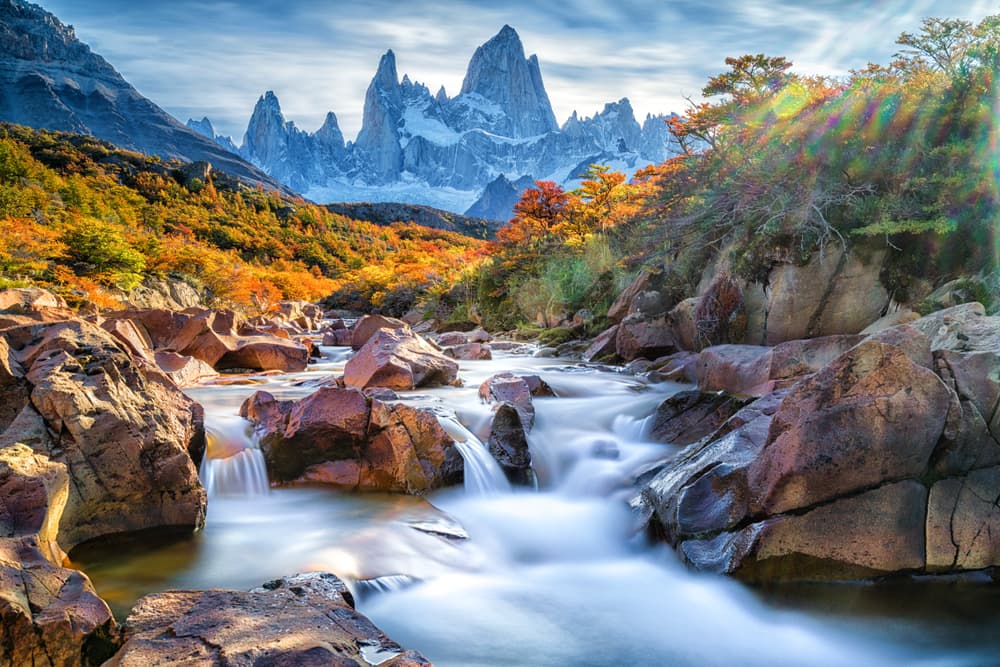
El Chaltén Fitz Roy
A village of 3,000 inhabitants at the foot of Fitz Roy and Cerro Torre, El Chaltén concentrates the most stunning trails in Argentine Patagonia, all accessible on foot from the main street.
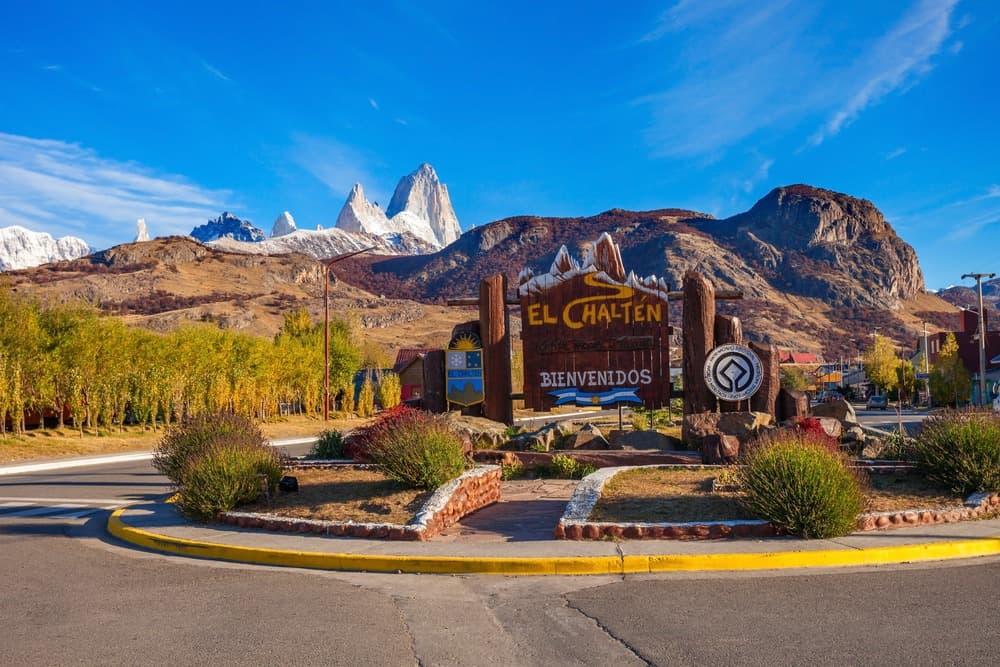
El Chaltén owes its existence to a border dispute. Founded in 1985 by Argentina to assert sovereignty against Chile in the continental ice fields zone, the village is not yet forty years old. Its 3,000 permanent residents live almost entirely from trekking, between hostels, refuges and equipment shops on San Martín Street, the only paved road. The contrast is striking: at the foot of the granite walls coveted by mountaineers worldwide, you find a town of corrugated metal and steep roofs, crossed by the Río de las Vueltas descending toward Lake Viedma.
Geography governs everything here. El Chaltén lies at the northern edge of Parque Nacional Los Glaciares, 220 kilometers north of El Calafate via Route 40 and Route 23, a three-hour drive across the steppe. The village sits in a north-south oriented valley, dominated to the west by two massifs: Cerro Fitz Roy (3,405 meters), which the Tehuelches called Chaltén, the smoking mountain, referring to the permanent clouds clinging to its summit, and Cerro Torre (3,128 meters), a granite needle topped with an ice mushroom, long considered unconquerable. Behind these peaks stretches the Hielo Continental Sur, the world's third-largest glacial mass after Antarctica and Greenland.
What makes El Chaltén distinctive is that all trails begin from the village. No 4x4 transfers, no preliminary boat rides. You pack your bag at the hostel and head out on foot. The Laguna de los Tres trail, which leads to the mirror lake beneath Fitz Roy's eastern face, takes 8 hours round-trip for 22 kilometers and 800 meters of elevation gain, with the final 400 meters very steep through moraine. The Laguna Torre trail, more moderate, takes 6 hours to reach the Grande glacier and its iceberg lake. Between the two, the Mirador Loma del Pliegue Tumbado offers a 7-hour panoramic view of both massifs from 1,500 meters altitude, generally less crowded.
Climate dictates the rhythm here. We are in a transitional zone between the Patagonian steppe and the ice fields, creating permanent meteorological instability. The summits of Fitz Roy and Cerro Torre remain hidden in clouds more than 250 days a year. The westerly wind, which strengthens crossing the cordillera, can reach 80 to 100 kilometers per hour on ridges even in high summer. Climbers sometimes wait three weeks in the village for a stable 48-hour window. For the hiker, the rule is simpler: build in margins, start early, accept that one day in two will be grey.
The village's social life concentrates around a few addresses. Cervecería El Bolsón serves locally brewed craft beer at the end of trekking days. Tapería Patagonia and La Vinería offer oven-roasted goat and dishes featuring trout from Lake San Martín. In the morning, you encounter guides from the local syndicate departing to scout conditions on the Cagliero glacier or the Filo Norte route. In the austral summer, from December to February, the village doubles its population: you hear Argentine Spanish, English, German, Polish, Japanese.
Beyond the two main trails, El Chaltén opens onto more challenging objectives: the Huemul circuit, a 4-day independent loop with two zip lines to cross glacial torrents and a vantage point over the Hielo Continental, or the crossing toward Lago del Desierto to the north, gateway to the Chilean border and Villa O'Higgins via lake and foot routes. These options cannot be improvised and require preparation that our English-speaking team organizes in advance.
Must-See
Laguna de los Tres at sunrise. Depart at 4 a.m. from the Río Blanco trail to reach the lake at the foot of Fitz Roy before raking light sets the eastern face ablaze in orange. The final 400 meters through glacial moraine are done by headlamp.
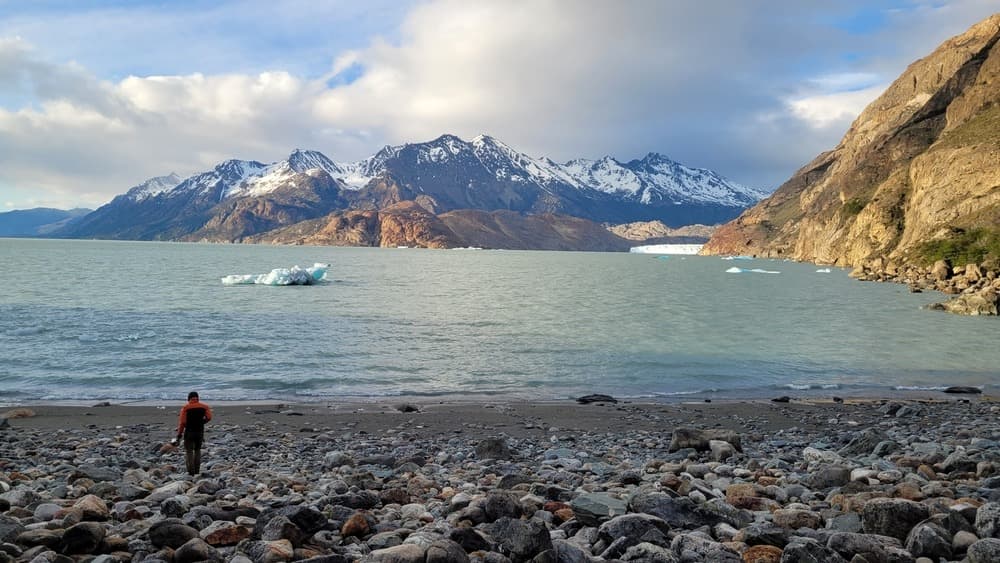
Mirador Maestri toward Cerro Torre. Six hours round-trip along the Río Fitz Roy to the Grande glacier, where detached icebergs float in Laguna Torre. The silhouette of Cerro Torre, when it clears, is one of the most recognizable peaks on the planet.
Lago del Desierto and the Chilean border. Located 37 kilometers north of the village by track, this 15-kilometer-long lake marks the entry to Villa O'Higgins in Chile. Boat crossing possible, followed by a trail reaching the Carretera Austral in two days.
Huemul loop in self-guided mode. 4-day trek with passage of Paso del Viento (1,500 m) opening onto a plunging 40-kilometer view of the Hielo Continental Sur. Two mandatory zip lines to cross the Río Túnel and Río Túnel Inferior.
Loma del Pliegue Tumbado ascent. Less-frequented trail than the two main classics, 1,500 meters of elevation gain to a plateau where you see Fitz Roy, Cerro Torre and Lake Viedma to the south simultaneously. Budget 7 to 8 hours.
When to Go
The practicable window extends from mid-November to mid-April. Peak season, December to February, offers long days (sunrise 5:30 a.m., sunset 10:30 p.m.), temperatures of 8 to 18°C during the day in the village and around 2 to 5°C on high trails. This is also the windiest period: gusts regularly exceed 80 km/h at Laguna de los Tres, sometimes making the final section dangerous. March and early April are our preferred period: winds weaken, the autumn colors of lengas (southern beech) turn red-orange, and trail traffic drops after mid-March. Morning temperatures then dip to 0°C, with possible first snows on the passes.
From May to September, most accommodations close, several trails are closed due to snow, and daylight is limited to 8 hours. October and early November remain unstable, with persistent snowpack above 1,000 meters making Laguna de los Tres impracticable without winter gear. For cleared summits, aim for late February, March and early April, statistically more stable than December-January despite conventional wisdom.
Practical Advice
We recommend a minimum of 3 nights on-site, 4 ideally. This margin allows you to absorb a bad-weather day (almost certain) and reserve your main ascent for the clearest window. With only 2 nights, the risk of never seeing Fitz Roy clear becomes significant. Access is exclusively by road from El Calafate (3 hours, Route 40 then Route 23), itself served by airport FTE receiving daily flights from Buenos Aires and Ushuaia. No airport at El Chaltén.
The most logical combination pairs El Calafate and glaciers (Perito Moreno, Upsala glacier) with El Chaltén: this is the northern diptych of Los Glaciares park, requiring 6 to 8 days total. Beyond that, many of our travelers continue to Torres del Paine in Chile (5 hours' drive and border crossing at Cerro Castillo), then Ushuaia. For marine wildlife, the Valdés Peninsula is accessed on a round-trip flight from Buenos Aires, without logical road connection to El Chaltén. Comfort at El Chaltén is adequate if unpretentious: family hostels and hotels, two or three recently opened upscale properties, straightforward dining. The region appeals primarily to independent hikers capable of 6 to 8 hours on rocky trails. For a contemplative traveler or families with young children, options exist (Mirador Los Cóndores in 1.5 hours, boat navigation on Lake Viedma to the glacier), but the village is fully experienced through hiking.