Torres del Paine
1,800 km² of granite, glaciers and pampa in southern Chile, explored via 4 to 10-day treks or from lodges overlooking the Cuernos.
Torres del Paine sprawls across 1,800 km² in southern Magallanes region of Chile, 112 km north of Puerto Natales. The park takes its name from three granite towers that rise to 2,850 meters, remnants of a laccolith laid bare by glacial erosion over 12 million years. Our team has worked this destination from our offices and we guide English-speaking travelers on formats ranging from day trips to complete ten-day treks.
The park's geography organizes around three defining elements. At the center, the Paine massif and its horns (the Cuernos), recognizable by their dark slate peaks set atop light granite bases. To the west, Grey Glacier descends from the Campo de Hielo Sur, the third-largest freshwater reserve on the planet after Antarctica and Greenland. To the south, the pampa opens onto Lakes Sarmiento, Nordenskjöld and Pehoé, their turquoise color arising from glacial flour suspended in the water. Guanacos, cousins of the llama, graze in herds of fifty to one hundred across the grassy plateaus, and the park shelters one of South America's last stable populations of wild pumas.
Climate is dictated by westerly winds that cross the Pacific unimpeded before striking the Andes. Gusts commonly reach 100 km/h between November and February, and it is not uncommon to encounter rain, sunshine and hail within the same hour of walking. Summer temperatures oscillate between 5 and 18°C by day, dropping near zero at night in high altitude. The austral winter, from June to August, transforms trails into snowy terrain: the park remains open but most refugios close, and only a limited number of operators function.
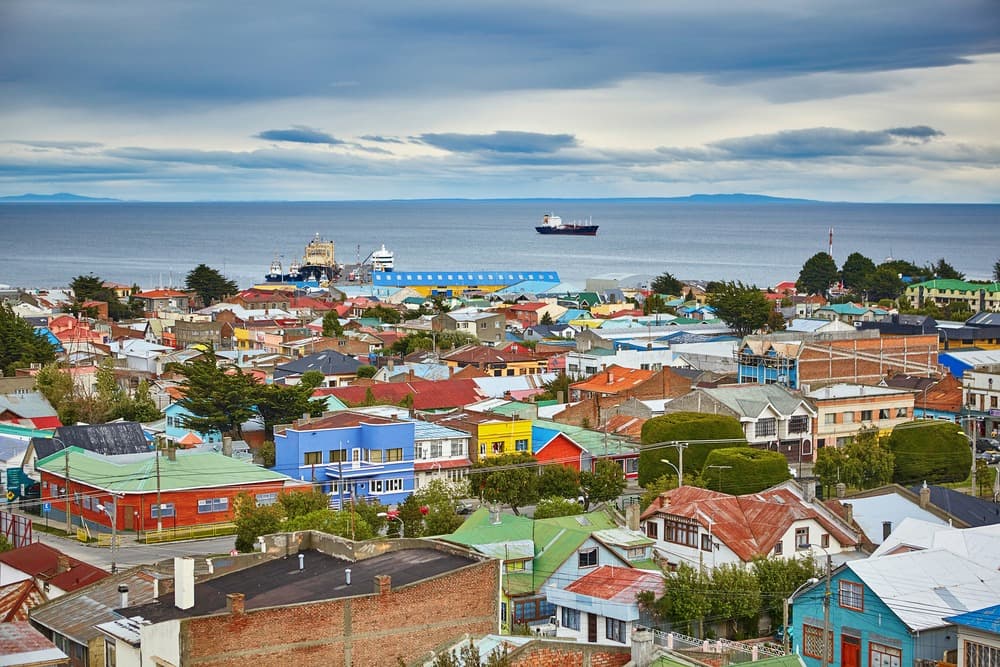
On the human side, the gateway is Puerto Natales, a former wool port of 22,000 inhabitants on the shores of Última Esperanza fjord. The town reinvented itself around trekking tourism from the 1990s onward, yet retains an economy tied to estancia, sheep heritage ranching of Yugoslav and British heritage established in the late 19th century. Here you eat asado de cordero patagónico, lamb roasted on a cross for four hours over lenga coals, and centolla, king crab from the Strait of Magellan, in season from October to June. Several historic estancias like Cerro Guido or Río Verde have opened to visitors and offer a reading of the territory through the eyes of its gauchos.
For the traveler, the question is not whether to come, but in what form. The W circuit, which connects the Torres viewpoint, the French Valley and Grey Glacier over 71 km, can be walked in 4 to 5 days sleeping in the Chileno, Francés, Paine Grande and Grey refugios. The grand O circuit adds the northern face of the massif and the John Garner pass at 1,180 meters, for 110 km total over 8 to 10 days. Lodges at the park's edge—Explora Patagonia on Pehoé's shores, Awasi in individual bungalows, Tierra Patagonia overlooking Lake Sarmiento—allow you to cover the same viewpoints on day excursions with evening returns to warmth and comfort.
We typically orient the choice based on three criteria: the ability to carry a 12-kilo pack over several days, tolerance for dormitory or tent nights, and availability during season. W refugio reservations open in July for the following season and fill within weeks for January and February.
Must-See
Base of the Torres at sunrise. A 9 km climb from Chileno refugio, with the final hour scrambling over moraine debris. Arrival at the glacial lake around 6:30 a.m. in summer, raking light on the three granite towers for about twenty minutes.
Navigation on Grey Lake. A one-and-a-half hour catamaran between Grey refugio and the glacier face, within 30 meters of blue seracs calving into the lake. Option to continue by kayak among detached icebergs.
French Valley and Britanico viewpoint. Ascent of the valley hemmed by the Cuernos and Cerro Paine Grande, 5 hours round trip from Italiano refugio. Audible avalanches cascade across the eastern face of the hanging glacier every hour.
Puma tracking in the Laguna Amarga sector. Dawn-guided outings with local trackers, former herders turned guides. The park concentrates some 50 to 100 pumas, the highest known density in South America.
Cerro Guido Estancia. A 100,000-hectare sheep operation on the park's northern border, managed since 1914. Shearing demonstrations, quincho meals with gauchos and observation of criollo horses from the corrals.
When to Visit
High season runs from mid-November to mid-March, with peak crowds in January and February. Daytime temperatures peak between 15 and 18°C, with daylight lasting up to 22 hours by late December. This is also the period of most violent winds, with gusts recorded at 120 km/h on exposed ridges at the John Garner pass. October, November and late March offer an interesting compromise: calmer wind, trail traffic cut by half, yet cool temperatures (3 to 12°C) and likelihood of snow falls in high passes.
From April to September, the park shifts to winter mode. Temperatures drop between -5 and 5°C, several trails close, and W refugios cease operations from May to September. This period opens specific formats: puma observation made easier by snow revealing tracks, photography of the Cuernos dusted with snow beneath clear skies. We operate from lodges that stay open year-round.
Practical Tips
We recommend a minimum of 4 full days at Torres del Paine for a lodge formula with three excursions, and 6 to 7 days for the complete W circuit on foot. Access is via Punta Arenas airport, then 3 hours' drive to Puerto Natales, and an additional 1.5 hours to the park entrances (Laguna Amarga or Serrano depending on itinerary). The most natural combination is with El Calafate and Perito Moreno Glacier on the Argentine side, 5 hours' drive via the Cerro Castillo border crossing, and with El Chaltén for walkers wishing to extend to Fitz Roy. A two-week itinerary comfortably covers all three sites.
The park suits trained hikers for trek versions, and contemplative or family audiences for lodge formula provided they accept constant wind. Children are admitted from age 8 in most day excursions. Comfort ranges from basic camping at €30 per night to all-inclusive lodges at €1,500 per person per day. We outfit each traveler with reinforced windbreaker, merino technical layers and high-cut boots: weather changes five to six times daily and poor equipment can cut a walk short.