Los Glaciares National Park
Los Glaciares National Park
Argentina's largest protected area, Los Glaciares National Park is home to Perito Moreno, Fitz Roy and Cerro Torre, designated a UNESCO World Heritage Site in 1981.
The Los Glaciares National Park, situated in Argentine Patagonia, stands as Argentina's largest protected area. With its imposing glaciers, mountain lakes and legendary snow-capped peaks, the park ranks as an essential stop on any Patagonia journey, along the iconic Route 40. Here's an overview of this immense field of snow, shaped by pristine wilderness over millennia.
History of Los Glaciares National Park
Los Glaciares National Park protects a vast region dominated by glaciers of the Southern Patagonian Ice Field, in Santa Cruz Province (Argentina). The current ice field and its glaciers represent merely a fraction of what the last great glaciation once encompassed. This glaciation is believed to have begun 100,000 years ago, reaching its peak roughly 20,000 years ago before halting abruptly approximately 10,000 years ago.
During its greatest advance, ice covered this entire section of Patagonia, exposing only peaks exceeding 1,000 meters in altitude. The erosive force of these massive glaciers, advancing from west to east, carved two broad, U-shaped valleys. Today these valleys are home to Lago Argentino in the south and Lago Viedma in the north.
In 1937, through Decree No. 105,433, protected reserve status was established for various territories in the Andean Patagonia. One of these was the Los Glaciares reserve.
In April 1945, under Decree-Law No. 9504, ratified by Law No. 13,895, this reserve officially became Los Glaciares National Park. Originally established to protect the southern Andean forests of Patagonia, the Patagonian steppe and an immense expanse of continental ice.
Los Glaciares National Park Today
Los Glaciares National Park encompasses a total area of 726,927 hectares (or 7,240 km²) in the Southern Andes region. The landscape is shaped by massive and permanent glaciation. The enormous glaciers belong primarily to the vast Southern Patagonian Ice Field. They feed the immense mountain lakes of Viedma and Argentino.
Despite the emphasis on majestic glaciers, this park harbors incredible landscape diversity—from granite peaks exceeding 3,000 meters in altitude to distinct ecosystems.
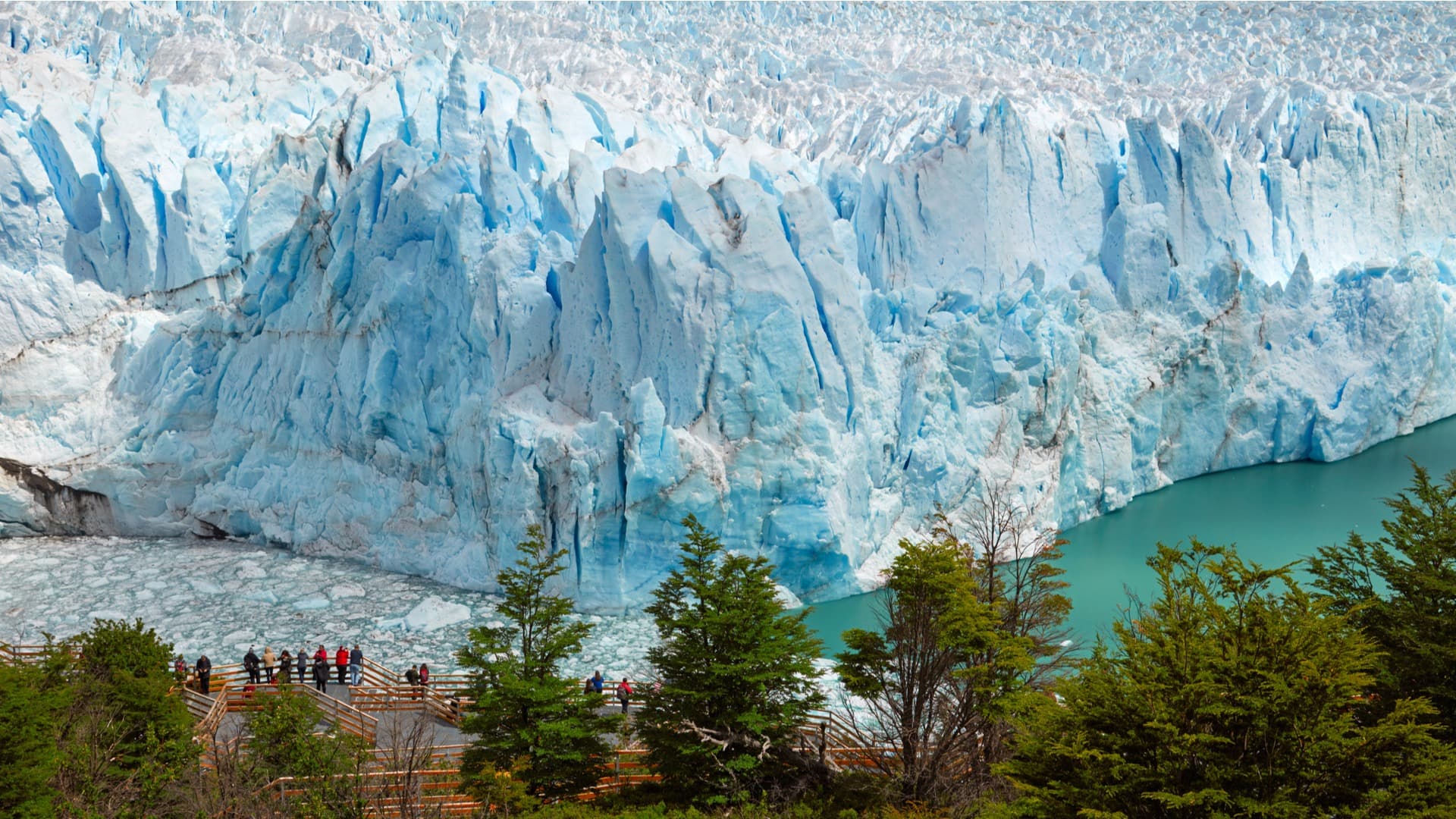
The meeting point between Perito Moreno Glacier and Lago Argentino represents a natural phenomenon that draws countless visitors annually. The vast glacier front advances gently and continuously into the waters of Lago Argentino.
From the city of El Calafate, located at the park's heart, various excursions can be arranged both by land and sea. Be sure to include the ascent of Fitz Roy and the trek to Cerro Torre, or sailing expeditions aboard a sailboat toward the bluish icebergs drifting across the glacial lakes.
Fly-fishing enthusiasts will test their skills at Lago Argentino, teeming with trout. The park also merits attention for its rich and varied wildlife, including condors, guanacos and pumas.
These natural wonders endow Los Glaciares Park with a mystical and wild character. Indeed, it was the first Argentine natural site to be designated a UNESCO World Heritage Site (in 1981).
Description of Los Glaciares National Park
The Glaciers Park lies in the southwest of Santa Cruz Province, on the border shared by Argentina and Chile. Its name derives from the multitude of glaciers covering half its total surface. Its landscape consists of snow to the west and Patagonian steppe to the east.
This immense ice cap feeds 47 glaciers, 13 of which flow toward the Atlantic slope on the Argentine side. There are also more than 200 independent small glaciers, lakes formed by glacial melt and celebrated peaks. Fitz Roy and Cerro Torre reach 3,375 and 3,102 meters respectively.
This glacial complex is exceptional for its remarkably low altitude. The glaciers here do not exceed 1,500m, whereas elsewhere glaciers typically descend no lower than approximately 2,500m before flowing into lakes. This spectacle is unique worldwide and absolutely not to be missed.
Flora and Fauna of Los Glaciares
The essential hikes lead to the foot of Cerro Fitz Roy (Laguna de los Tres) and Cerro Torre (Laguna Torre). Beginner hikers may find these challenging, but the scenery is truly worth contemplating. Along the trekking days, you discover dense forests of southern beech (Lenga), Calafate shrubs, yellow orchids and other delicate flowers.
On hikes, it is common to encounter various bird species. The majestic condor can be spotted from the Mirador de Cóndores. You'll also encounter the white-throated caracara, the Magellanic woodpecker, the black-chested eagle-buzz, the chucao, various passerine species, the rufous collared sparrow and the austral pygmy-owl. Keep your eyes open, as the endangered huemul deer occasionally makes appearances.
Los Glaciares National Park: A Nature Escape in Patagonia
Los Glaciares Park, the world's third-largest ice field after Antarctica and Greenland, captivates with its grand landscapes. Here you challenge the vertiginous peaks of Fitz Roy or the Torres del Paine. You navigate the glacial and milky waters of the immense Lago Argentino. You brush the fingertips against the monstrous Perito Moreno or Upsala glaciers.
Here, nature preserved and wild inspires awe. 356 glaciers tumble into lakes of glacial blue. Hikers flock to trek along trails crisscrossing the Fitz Roy massif. Thrill-seekers prefer to attempt the ascent of Perito Moreno Glacier. The long sunsets from remote estancias and wind rustling across the pampa attract those seeking tranquility.
The Glaciers
Perito Moreno Glacier
Most of the park's celebrated glaciers rise along the various arms of Lago Argentino. Thus, Perito Moreno Glacier impresses with its dimensions, particularly its 5,000-meter-wide front and striking blue depths.
This glacier is named in tribute to geographer and explorer Francisco Moreno, who discovered it during one of his 19th-century expeditions. At 254 km² in area, Perito Moreno ranks as Argentina's 3rd largest glacier (after Viedma and Upsala).
Easy to access (by sea or land), stable after each glacial melt, spectacular—reasons abound to contemplate this glacier. Come admire this icy wall rising over 60 meters high, with its shimmering colors and jagged surface. Occasionally, at the end of winter, an ice bridge forms between land and glacier.
During the snowmelt season (January to March), the wall fractures, ruptures and spills into the milky turquoise waters of Lago Argentino. The deep and monstrous roars of calving icebergs provide the climax—a magical moment awaited by nature lovers.
Other Glaciers
Other glaciers feed Lago Argentino in the park's south, including Upsala and Spegazzini. These glaciers can be visited by boat from El Calafate. Spegazzini in particular straddles the Chile-Argentina border. Its height varies between 80 and 125 meters. Its length reaches 125 km.
Further north, Viedma Glacier is an impressive and extremely active glacier. It feeds the great Lago Viedma, accessible from El Chaltén. Other lesser-known but equally compelling glaciers exist, such as Torre and Piedras Blancas.
The Peaks
Cerro Chaltén or Fitz Roy
At the park's northern extremity stand the celebrated jagged granite peaks of Fitz Roy (3,405 meters elevation), a formidable challenge for mountaineers. Originally named "Chaltén" ("fire peak") by the indigenous Tehuelche people, it was later renamed by Captain Fitzroy. This summit proves quite difficult to climb, best attempted once yearly.
Cerro Torre
Another distinctive peak is Cerro Torre. While far less famous than Fitz Roy, its imposing silhouette dominates the horizon. The full-day hike to Laguna Torre, departing El Chaltén, is quite challenging and leads directly to this peak's base.
The Lakes
The park's two major lakes are fed by glacial meltwater. This imparts their milky blue coloration. The contrast is all the more striking with glacial backdrops gleaming brilliant white-blue and verdant landscapes surrounding them.
Lago Viedma
North of El Chaltén lies Lago Viedma, fed by the enormous Glaciar Viedma. Stretching 80 km long with surface area fluctuating between 1,088 and 1,600 km², partially included within the Glaciers Park, it is known for its magnificent turquoise waters. Nearby rises majestically the 3,000-meter wall of Cerro Torre, standing 800m high.
Lago Argentino
South of El Chaltén lies Lago Argentino, considered Argentina's largest lake (160 km long). It is fed by Perito Moreno, Upsala and Spegazzini glaciers. Its waters flow into the Río Santa Cruz, eventually reaching the Atlantic Ocean. Lake navigation occurs between shorelines dotted with small shrubs and icebergs. One of the lake's arms terminates at Upsala Glacier.
The Towns
El Chaltén
El Chaltén, gateway to Los Glaciares' northern zone, is a pleasant village nestled near Fitz Roy. It sits near one of the most impressive peaks of the Andes Cordillera (3,441 meters). On clear days, you enjoy unobstructed views of this summit from El Chaltén.
This privileged location makes El Chaltén Argentina's trekking capital. Beyond hiking trails, this town brims with small bars and restaurants for relaxation after physical exertion. It also features a major airport and several well-maintained transport connections.
El Calafate
The village of El Calafate serves as the gateway to Los Glaciares National Park's southern section, and the primary access point to the imposing Perito Moreno Glacier. This town ranks among Argentina's major tourist centers, boasting a long commercial avenue lined with restaurants, travel agencies and eateries.
Climate
Los Glaciares National Park enjoys a cool and humid climate, with average temperatures of −3°C, especially at higher elevations. In summer, temperatures reach a maximum of 13.4°C.
Average annual precipitation measures 500 mm in the west and 900 mm in the east. This rainfall is uniformly distributed throughout the year. Snowfall is frequent during winter, accompanied by winds from the Pacific.
Two entry points provide access to the National Park: El Calafate in the south and El Chaltén in the north. Free shuttle services are available.
Interested in this visit?
We can include it in your personalised itinerary.